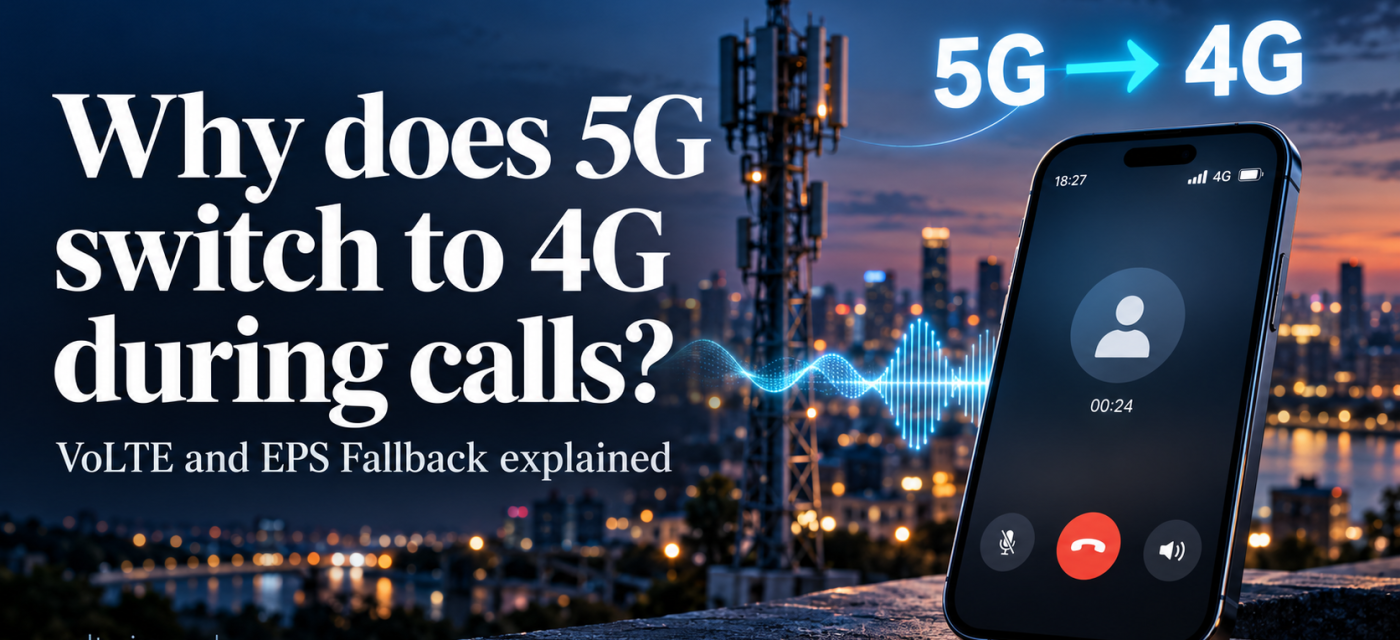
You’re on 5G, you start a phone call, and the icon at the top of the screen quietly changes to 4G. Hang up, and a few seconds later it’s back on 5G. So why does your phone switch from 5G to 4G during calls? In almost every case, because the network is doing exactly what it was designed to do.
It looks like a downgrade, and plenty of people assume their phone, SIM or signal is at fault. It usually isn’t. Most 5G in the UK still relies on 4G for voice, and even the newer, purer kind of 5G often hands calls to 4G on purpose. This guide explains why it happens, how to tell normal behaviour from a real fault, and what to do if your calls are actually failing.
Your phone switches from 5G to 4G during calls because the call is being carried by VoLTE, voice over 4G. On 5G Non-Standalone networks, voice always uses the 4G side. On 5G Standalone networks without VoNR (voice over 5G), the network moves you to 4G for the call using EPS Fallback, then returns you to 5G afterwards. It’s normal and not a fault, unless you drop below 4G or calls fail.
5G to 4G during calls: at a glance
| What you see | What it means | Is it a problem? |
|---|---|---|
| 5G changes to 4G or LTE during a call, then returns | The call is on VoLTE, either via the 4G anchor or EPS Fallback | No. Normal behaviour |
| Stays on 5G for the whole call | You’re on VoNR, true 5G voice | No. That’s the newest option |
| Drops to E, G, GPRS or H during calls | The phone isn’t using VoLTE and is falling back to 2G | Yes. Fix it before 2G closes |
| Calls fail or ring out as the icon changes | The handover to 4G for the call isn’t completing | Yes. See the fixes below |
| Stays on 4G long after the call ends | Slow return to 5G after the call | Annoying, not serious |
There are two kinds of 5G, and they handle calls differently
The single most useful thing to understand is that “5G” on your screen can mean two quite different networks. Which one you’re on decides how your calls are carried.
5G Non-Standalone (NSA): 5G for data, 4G for everything else
When 5G arrived in the UK in 2019, operators bolted 5G radio onto their existing 4G networks. Your phone keeps a 4G connection as its anchor, and 5G is added on top as a fast lane for data. The 4G core network still runs the show, including voice.
On 5G NSA, calls are VoLTE, full stop. Some phones keep showing 5G during the call because the data side is still using 5G; others switch the icon to 4G because the call is on the 4G anchor. Either way, the voice was never on 5G in the first place.
5G Standalone (SA): a proper 5G network, with a choice for voice
5G Standalone uses a new 5G core with no 4G anchor. UK networks have been rolling it out since 2023, sometimes under names like 5G+ or 5G Ultra. Because there’s no 4G underneath, calls need a plan. There are two:
- VoNR (Voice over New Radio): the call stays on 5G, handled by the same IMS voice system that runs VoLTE. EE calls this 5G Calling.
- EPS Fallback: when the call starts, the network moves your phone to 4G, the call runs as VoLTE, and you go back to 5G afterwards.
VoNR needs the network, the area, the phone, its software and your plan all to support it. Where any of those is missing, EPS Fallback takes over. Which is why many people on shiny new 5G SA still see 4G during every call.
What is EPS Fallback?
EPS stands for Evolved Packet System, the formal name for the 4G network. EPS Fallback is the 3GPP-standard way for a 5G Standalone network to get a call connected when it can’t, or won’t, carry the voice on 5G itself.
Here’s what happens in the second or so after you press call, or someone calls you:
The IMS registration that makes calls possible stays in place throughout, because VoLTE and VoNR use the same IMS voice system. Only the radio connection underneath changes. That’s why EPS Fallback works smoothly most of the time, and why it depends completely on VoLTE being healthy. If VoLTE is broken on your phone or account, EPS Fallback has nothing to fall back to.
Why don’t networks just use VoNR everywhere?
Because VoNR is still young. It needs good, continuous 5G Standalone coverage, otherwise a call that starts on 5G has to be handed over to 4G mid-conversation as you move, which is harder to do cleanly than starting the call on 4G in the first place. It also needs every phone model, firmware version and tariff to be tested and enabled. EPS Fallback lets networks launch 5G SA now and switch VoNR on area by area, device by device, as it’s proven.
In the UK, EE launched VoNR as 5G Calling in June 2025, and Vodafone and O2 have also enabled voice over 5G SA for some plans and phones. O2 has said it needs a newer SIM as well as a compatible phone. Availability changes quickly, so check your own network’s 5G voice page for the current position. For more on 5G voice itself, see our VoNR guide and vonr.co.uk.
NSA, SA with EPS Fallback, and VoNR compared
| 5G NSA | 5G SA with EPS Fallback | 5G SA with VoNR | |
|---|---|---|---|
| Where the call runs | 4G (VoLTE) | 4G (VoLTE) | 5G (VoNR) |
| Icon during the call | 5G or 4G, depending on phone | Usually 4G | Stays 5G |
| Call set-up | Normal VoLTE speed | Slightly slower, network changes first | Fastest |
| Data speed during the call | Can stay on 5G | 4G speeds | 5G speeds |
| Needs working VoLTE? | Yes | Yes | Yes, as backup when leaving 5G SA |
Look at the last row. Whichever kind of 5G you’re on, VoLTE is still holding up your calls. That’s why fixing VoLTE fixes most “5G phone can’t make calls” problems.
When switching to 4G during calls is a problem
The switch itself is fine. These are the signs that something underneath it isn’t.
Your phone drops to E, G, GPRS or H
That’s not 4G, it’s 2G or old 3G labelling, and it means the phone isn’t using VoLTE at all. It’s falling back to the old circuit-switched network for every call, losing usable data while it does. With 3G gone, that fallback lands on 2G, which UK networks start switching off from 2029. Get VoLTE working now. Our VoLTE problems guide covers the causes and fixes.
Calls fail, drop or go to voicemail as the icon changes
Occasionally the move from 5G to 4G doesn’t complete cleanly, especially at the edge of 5G SA coverage or with early firmware. Typical signs are calls that fail to connect first time, incoming calls that never ring, or calls that drop within the first few seconds. As a test, set your phone to prefer 4G and make a few calls:
- iPhone: Settings > Mobile Service > Mobile Data Options > Voice & Data, and choose 4G or LTE.
- Android: Settings > Network & internet (or Connections) > SIMs or Mobile networks > Preferred network type, and choose 4G or LTE.
If calls become reliable on 4G only, VoLTE is fine and the problem is in the 5G SA voice path for your phone, area or plan. Install any software and carrier settings updates, then report it to your network with the phone model and location. Switch 5G back on afterwards.
Your phone stays on 4G long after the call
Networks bring phones back to 5G after a call, but how fast depends on network settings and the phone. A few seconds is normal; minutes is sluggish but harmless. If it never returns until you restart or toggle aeroplane mode, update the phone and carrier settings, and mention it to your network.
Calls fail on 4G as well
Then this was never a 5G problem. It’s VoLTE: usually IMS registration, account provisioning or a phone that isn’t approved for 4G Calling on your network. Start with our step-by-step VoLTE diagnosis.
| Symptom | Most likely cause | First thing to try |
|---|---|---|
| 5G to 4G during calls, everything works | EPS Fallback or NSA voice | Nothing. It’s normal |
| Drops to E, G or H during calls | VoLTE not working, falling back to 2G | Check 4G Calling is enabled and provisioned |
| First call attempt fails on 5G SA | EPS Fallback not completing | Test with 4G preferred, update software, report |
| Incoming calls missed on 5G only | Paging or fallback issue on 5G SA | Test with 4G preferred, report with location |
| Stuck on 4G after calls | Slow return to 5G | Aeroplane mode on and off, update |
| Calls fail on 4G too | VoLTE or IMS registration fault | Follow the VoLTE diagnosis steps |
Things most people don’t know about 5G calls
- Wi-Fi Calling skips all of this. If your phone is on Wi-Fi Calling, the call doesn’t use 5G or 4G radio at all, so the icon won’t change. It’s the same IMS voice service over a different connection.
- Turning 5G off doesn’t make calls worse. Voice quality on VoLTE and VoNR comes from the same codecs and the same IMS core. You only lose 5G data speeds.
- HD voice doesn’t need 5G. VoLTE already carries wideband HD Voice. VoNR adds faster set-up and can use the EVS codec, but only when both ends support it.
- Roaming abroad, the rules change. 5G SA and VoNR rarely work while roaming yet, so expect calls abroad to use VoLTE on 4G, if the VoLTE roaming agreement exists.
- Routers and IoT devices do it too. 5G modules in routers and gateways with phone ports use the same EPS Fallback, so they need working VoLTE and the right operator profile just like a phone. See VoLTE in routers and IoT.
FAQs
Why does my phone switch from 5G to 4G during calls?
Because the call is carried by VoLTE on 4G. On 5G Non-Standalone networks voice always uses the 4G side, and on 5G Standalone networks without VoNR the network moves you to 4G for the call using EPS Fallback. It’s normal.
Is it bad that my phone goes to 4G when I make a call?
No. It only indicates a problem if the phone drops below 4G, to E, G or H, or if calls fail as the network changes.
What is EPS Fallback?
A 5G Standalone feature that moves a phone to 4G when a call starts, so the call can be carried as VoLTE, then returns it to 5G afterwards. It’s used where voice over 5G (VoNR) isn’t available.
How do I make calls over 5G?
You need VoNR, which requires 5G Standalone coverage, a compatible phone and software, and a network and plan that offer it. EE calls it 5G Calling. Where it’s available, it switches on automatically.
Do I still need VoLTE if I have 5G?
Yes. 5G NSA uses VoLTE for every call, EPS Fallback relies on VoLTE, and VoNR calls hand over to VoLTE when you leave 5G Standalone coverage.
For everything else that can go wrong with 4G and 5G calling, read VoLTE Explained: The Things Nobody Tells You About 4G Calling.