Two phones, same network, same SIM type, same four bars of 4G. One makes calls perfectly. The other can browse all day but every call fails or goes straight to voicemail. The difference is almost always IMS. So what is IMS, and why does a part of the network most people have never heard of decide whether your phone can actually phone anyone?
IMS is the system that runs voice on modern mobile networks. It sits behind every VoLTE call, every Wi-Fi Calling call and every 5G voice call, and since the UK switched off 3G it has quietly become the only way most phones make calls at all. This guide explains what it is, how it works, what its parts do, and why it’s usually the first place to look when calls fail.
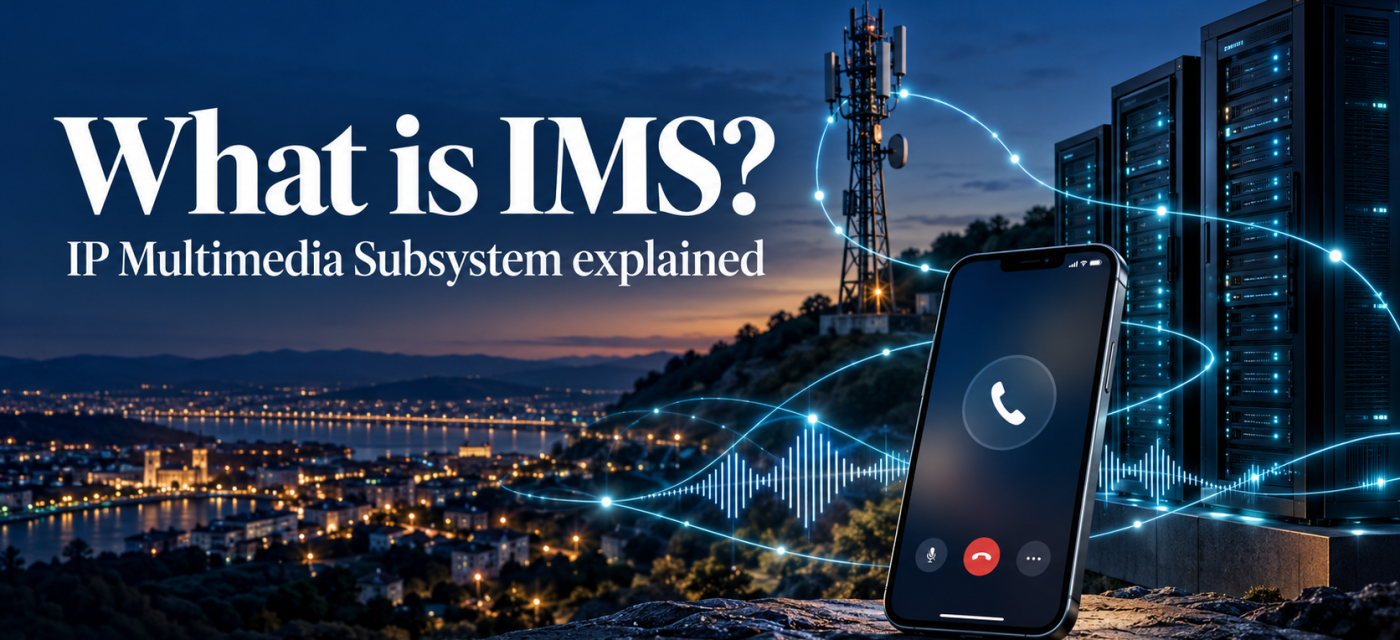
IMS (IP Multimedia Subsystem) is the part of a mobile operator’s network that controls voice calls, SMS over IP and related services over IP. It’s standardised by 3GPP, uses SIP to set up calls, and powers VoLTE, Wi-Fi Calling and VoNR. Before your phone can make or receive a 4G or 5G call, it has to register with IMS.
What is IMS? At a glance
| Stands for | IP Multimedia Subsystem |
|---|---|
| Defined by | 3GPP, first introduced in Release 5. Architecture in TS 23.228. GSMA IR.92 profiles it for VoLTE. |
| Signalling protocol | SIP (Session Initiation Protocol), the same family of protocol used by internet phone systems |
| Services that run on it | VoLTE, Wi-Fi Calling (VoWiFi), VoNR, SMS over IP, video calling, RCS, and many fixed-line digital voice services |
| Who runs it | Your mobile operator, in its core network. It’s not an app and not on your phone. |
| What your phone has to do | Connect to the IMS APN, then register with IMS using credentials on the SIM |
| Why it matters now | With 3G gone and 2G closing from 2029, IMS is the only route to voice on 4G and 5G |
Why mobile networks needed IMS
On 2G and 3G, phone calls used circuit switching. When you dialled, the network reserved a dedicated path for your call from one end to the other and held it open until you hung up. It was reliable, simple and wasteful, and the equipment that ran it was a completely separate world from mobile data.
4G changed the rules. LTE was designed as an all-IP network with no circuit-switched voice at all. Everything is packets. That’s brilliant for data, but it left an awkward question: if there’s no circuit to reserve, how do you make a phone call that’s as reliable as the old one, with a proper phone number, billing, emergency calling, call forwarding and voicemail, and with nobody’s Netflix stream allowed to make it stutter?
The answer was IMS. It takes the idea behind internet phone systems and turns it into an operator-grade service: authenticated by your SIM, tied to your number, given guaranteed priority on the radio, and connected to every other phone network in the world. VoLTE is simply “voice calls using IMS over 4G”.
For a while networks hedged their bets with CSFB, dropping 4G phones back to 2G or 3G for each call. That route is closing. Our VoLTE problems guide covers what happens to phones still relying on it.
How IMS works, the plain English version
Think of IMS as an old-fashioned switchboard, rebuilt for the internet age. Before it will connect any calls for you, you have to tell the switchboard you’re here and prove who you are. That’s registration. Once you’re registered, the switchboard knows where to reach you, which services you’re allowed, and which number is yours.
When you dial, your phone sends a request to the switchboard. The switchboard checks your account, works out where the other person is (on the same network, a different mobile network, a landline or abroad), sets up the call, and tells the radio network to give it a reserved lane so the audio stays clean. When somebody calls you, the switchboard looks up where you’re registered and rings you there. If you’re not registered, it can’t find you, so the call goes to voicemail.
Your phone reaches the switchboard over its own private connection, the IMS APN, which is separate from the connection your apps use. That’s why mobile data can work perfectly while calls fail: they’re travelling on different roads to different places.
The parts of IMS, without the jargon headache
IMS specifications are famous for acronyms. You only need a handful to understand nearly every VoLTE conversation, fault report or module log you’ll ever see.
| Part | What it does | Switchboard version |
|---|---|---|
| P-CSCF Proxy Call Session Control Function | The first IMS node your phone talks to. Relays all SIP signalling, secures the link to the device and asks the policy function to reserve quality for calls. | The front door |
| I-CSCF Interrogating CSCF | The entry point into your home network. Asks the HSS which S-CSCF should look after you and routes requests there. | The receptionist |
| S-CSCF Serving CSCF | Handles registration and authentication, keeps track of where you are, and routes every call and message you make or receive. | The operator at the board |
| HSS Home Subscriber Server | The subscriber database: your identities, authentication keys and whether your account is allowed IMS voice at all. | The customer records |
| TAS Telephony Application Server | Runs the phone features: call forwarding, call waiting, barring, caller ID and conference calls. | The rule book |
| MGCF and MGW Media Gateway Control Function and Media Gateway | Connect IMS calls to networks that don’t speak IMS, converting both signalling and audio. | The line to the outside world |
| PCRF / PCF Policy functions (4G / 5G) | Tell the radio network to create the guaranteed-priority bearer for the voice once a call is set up. | The person clearing the lane |
There are more, including the E-CSCF for emergency calls, media resource functions for announcements and conferencing, and border controllers that protect IMS where it meets other networks. But if you understand the seven above, you understand IMS. Our VoLTE glossary covers the rest.
IMS registration: the step everything depends on
If there’s one IMS concept worth remembering, it’s registration. No registration, no calls, in either direction. It’s the single most useful word in VoLTE troubleshooting, and the one most support scripts never mention.
When a phone or module connects to 4G or 5G, it opens the IMS APN, learns the address of its P-CSCF, then sends a SIP REGISTER message. The network answers with a challenge, the SIM works out the correct response, and if everything checks out the S-CSCF replies “200 OK”. The device is now IMS registered and stays that way by re-registering periodically.
Why IMS registration fails
| Where it stops | Typical cause |
|---|---|
| IMS APN never connects | Device not configured for IMS, wrong or missing IMS APN, operator profile missing on a module |
| REGISTER gets no answer | Wrong P-CSCF address, IPv4/IPv6 mismatch, the network not offering IMS voice in that area |
| Registration rejected | Account not provisioned for IMS voice in the HSS, data-only SIM, barred service |
| Registers, then drops | Re-registration timers missed, power-saving modes on IoT modules, network or firmware bugs |
How to check IMS registration
On many Android phones, dialling *#*#4636#*#* opens a Phone information screen showing “IMS registration: Registered” or “Not registered”. Some manufacturers block it, and some show the same thing under Settings > About phone > Status. iPhones don’t expose it, so you test by behaviour instead, as described in the iPhone section of our VoLTE guide. On cellular modules, the standard 3GPP commands tell you directly:
AT+CIREG=2      turn on IMS registration reporting
AT+CIREG?       IMS registration status (1 = registered)
AT+CAVIMS?      is voice over IMS available right now
AT+CASIMS?      is SMS over IMS available right now
AT+CGDCONT?     list PDN contexts: check the ims APN is there
One IMS, many services
Here’s the part that makes IMS clever, and occasionally maddening. VoLTE, Wi-Fi Calling and VoNR aren’t three different phone services. They’re one service, IMS voice, reached over three different connections.
Because it’s all one system, a call can start on Wi-Fi Calling at home and hand over to VoLTE as you walk down the drive, without dropping. Your number, voicemail and call forwarding are the same whichever route you’re on. And on 5G Standalone, VoNR uses exactly the same IMS core, just with a 5G radio and core in front of it. More on that at vonr.co.uk.
The flip side is that one IMS problem can take out all three at once. If your account isn’t provisioned for IMS voice, Wi-Fi Calling won’t rescue you, because it needs the same registration. And if Wi-Fi Calling works but VoLTE doesn’t, IMS itself is fine and the fault is in the 4G route to it: the IMS APN, the device’s operator profile, or the network’s VoLTE support for that phone.
| Service | Connection to IMS | Needs |
|---|---|---|
| VoLTE (4G Calling) | 4G LTE and the IMS APN | LTE coverage, VoLTE-capable device, IMS-provisioned account |
| VoNR (5G Calling) | 5G Standalone and the IMS data session | 5G SA coverage and a VoNR-enabled device, network and plan |
| Wi-Fi Calling (VoWiFi) | Any Wi-Fi, through an encrypted tunnel to the operator’s ePDG | Wi-Fi Calling support on the device and account |
| SMS over IP | Any of the above | Network and device configured to send SMS through IMS |
IMS for routers, modules and IoT devices
Phones arrive with IMS settings for each network built in. Cellular modules and routers often don’t, which is why “4G works but the phone port is dead” is such a common complaint with PSTN replacement gateways, alarm diallers and lift lines.
For a module to use IMS voice, it needs IMS support in its firmware, IMS switched on, an IMS APN context, the right operator profile for the network (MBN files on Qualcomm-based modules), and a SIM provisioned for voice. Miss one and data carries on regardless while IMS never registers. Changing IMS settings can also change how the module sends SMS, so always retest texts afterwards. Our routers and IoT guide goes into the device side, and if you need a SIM that’s actually provisioned for IMS voice rather than a data-only SIM, you can get a VoLTE SIM matched to your device.
IMS isn’t only mobile, either. Many fixed-line digital voice services that replace analogue phone lines run on IMS cores too. As the UK’s analogue network closes, IMS is becoming the common platform for voice whether it arrives over a mobile mast or a broadband line.
IMS vs VoIP: what’s the difference?
Both carry voice as IP packets and both use SIP, so it’s a fair question. The difference is who controls it and what it guarantees.
| IMS voice (VoLTE, VoNR, VoWiFi) | Internet VoIP and apps | |
|---|---|---|
| Run by | Your mobile operator | An app or VoIP provider |
| Identity | Your SIM and mobile number | An app account or SIP login |
| Call quality on mobile | Guaranteed-priority voice bearer on the radio | Best effort, competes with all other data |
| Emergency calls | Supported, with network-provided location | Limited or not at all |
| Uses your data allowance | No, billed as voice | Yes |
| Works with no data plan | Yes | No |
IMS FAQs
What does IMS stand for?
IP Multimedia Subsystem. It’s the part of a mobile operator’s core network that controls voice, SMS over IP and other real-time services over IP.
Is IMS the same as VoLTE?
No. IMS is the system; VoLTE is one service that uses it. VoLTE means voice calls handled by IMS over a 4G LTE connection. Wi-Fi Calling and VoNR use the same IMS over Wi-Fi and 5G.
Does IMS need an ISIM?
No. A SIM can carry an ISIM application with dedicated IMS identities, but IMS can also authenticate using the ordinary USIM, and many networks work that way. What matters is that the account is provisioned for IMS voice.
What is IMS registration?
The process where a phone or module identifies itself to the IMS core using SIP and SIM-based authentication. Until it’s registered, the device can’t make or receive VoLTE, VoNR or Wi-Fi Calling calls.
Why does my phone say IMS not registered?
Usually because the account isn’t provisioned for VoLTE, the phone isn’t approved or configured for that network, or the IMS APN isn’t connecting. Toggling aeroplane mode forces a fresh attempt; if that fails, ask the network to check 4G Calling is enabled on the account.
Does IMS work on 5G?
Yes. 5G Standalone networks use the same IMS core for VoNR. Where VoNR isn’t available, the phone moves to 4G for the call and uses VoLTE through the same IMS.
For the full list of what goes wrong with VoLTE and how to fix it, read VoLTE Explained: The Things Nobody Tells You About 4G Calling. Our standards page lists the 3GPP and GSMA documents behind IMS.